Fluted Glass: The Architect's Complete Guide to Texture, Light & Privacy
Architects specify fluted glass for shower enclosures, sliding partitions, and pivot doors. Finishes, thicknesses, applications — from NUMAEX, Ahmedabad, est. 1932.
Fluted glass is glass with a pattern of parallel vertical channels pressed or rolled into one surface during manufacture. The ridges scatter incoming light — softening it, slowing it — while the plane behind remains legible only as shape and shadow. You see movement. Not detail. That distinction is, architecturally, everything.
Indian interiors have reached for fluted glass with unusual urgency over the last four years. The reasons are several: a renewed appetite for material surface after a decade of flat, painted walls; the influence of mid-century Scandinavian and Japanese residential references; and, practically, the need to divide open-plan apartments without making them feel smaller. A textured glass surface does what a solid wall cannot — it passes light from one zone to the next while withholding the view. Light moves. Privacy holds.
NUMAEX has worked with architectural glass since 1932. Fluted glass — in various channel depths, glass types, and system configurations — has been part of the specification vocabulary since the 1960s. What follows is the working reference for architects and project managers who need to specify it correctly.
How Fluted Glass is Made
The profile is formed while the glass is molten — rollers press the channel pattern into the surface before the sheet cools. The result is a monolithic piece: the texture and the glass are not separate layers, not applied, not adhered. Channel depth typically runs from 3 mm to 8 mm depending on the pattern. Deeper channels produce more dramatic light scatter; shallower ones allow more visual resolution through the pane.
For architectural applications, the base glass is subsequently toughened — heated to approximately 620°C and rapidly quenched — producing a pane that, under load, fractures into small blunt pieces rather than long shards. In wet environments (shower enclosures, pool-adjacent walls), toughened fluted glass is not optional. It is the code-compliant minimum.
Low-iron glass shifts the tint. Standard float glass carries a green edge — visible at thickness, at joints, at the cut face. Low-iron fluted glass is optically clearer, reading as closer to white or neutral. In spaces with pale stone or white joinery, the distinction is worth the specification.
Applications
Shower Enclosures — PALOMA
The shower enclosure is where fluted glass is most consistently specified — and where the specification decisions carry the most consequence. Water, steam, humidity, and daily mechanical contact all act on the installation simultaneously.
PALOMA shower enclosures are available in fluted glass across four configurations: L-Type, Walk-In, U-Type, and floor-to-ceiling. The aluminium profiles are 3.5 mm wall thickness — tested under static load before leaving the factory. Hinges source from AGB, Italy. Seals are silicon-set, continuous, and checked against water ingress rather than simply against drip. These are not style decisions. They are the components that determine whether an enclosure remains watertight after five years of daily use.
In the shower context, fluted glass does specific work. The channel pattern breaks the reflective plane — so the enclosure does not read as a mirror or as a hard, institutional surface. Steam gathers in the channels and disperses more evenly. And the tactile quality of the surface — running a hand along the ridges — is immediately distinguishable from flat glass in a way that matters to clients who use the space every day.
Specify: 10 mm toughened fluted glass, low-iron where the stone or tile palette is pale, matte or satin aluminium frame finish.
Sliding and Folding Partitions — SHOJI
The partition application is where fluted glass most visibly reshapes a floor plan. A solid wall closes. A clear glass partition exposes. Fluted glass occupies the position between — it allows a room to read as larger than its square footage because borrowed light crosses the division, while the occupation of the adjacent space remains private.
SHOJI sliding and folding partition systems accommodate fluted glass in both primary configurations: SUKI Minimal (single profile, clean sightline, suited to bedrooms and studies) and SHOGUN dual-tone (two-finish frame, suited to feature walls and hospitality interiors). Panel heights reach 4,200 mm — sufficient for a full floor-to-slab installation in most residential projects. A panel at that height, in fluted glass, with light behind it: the wall becomes the feature.
The track is top-hung or bottom-guided depending on the floor specification. For stone or large-format tile floors, a top-hung configuration leaves the floor plane uninterrupted. For carpet or timber, the bottom guide is typically quieter in operation.
Fluted glass in a SHOJI system requires panel-by-panel alignment of the channel orientation during installation. The ridges should run continuously across adjacent panels — a detail that the factory addresses at the cutting stage, but one worth confirming at the shop drawing review.
Heavy Pivot Doors — ZEN
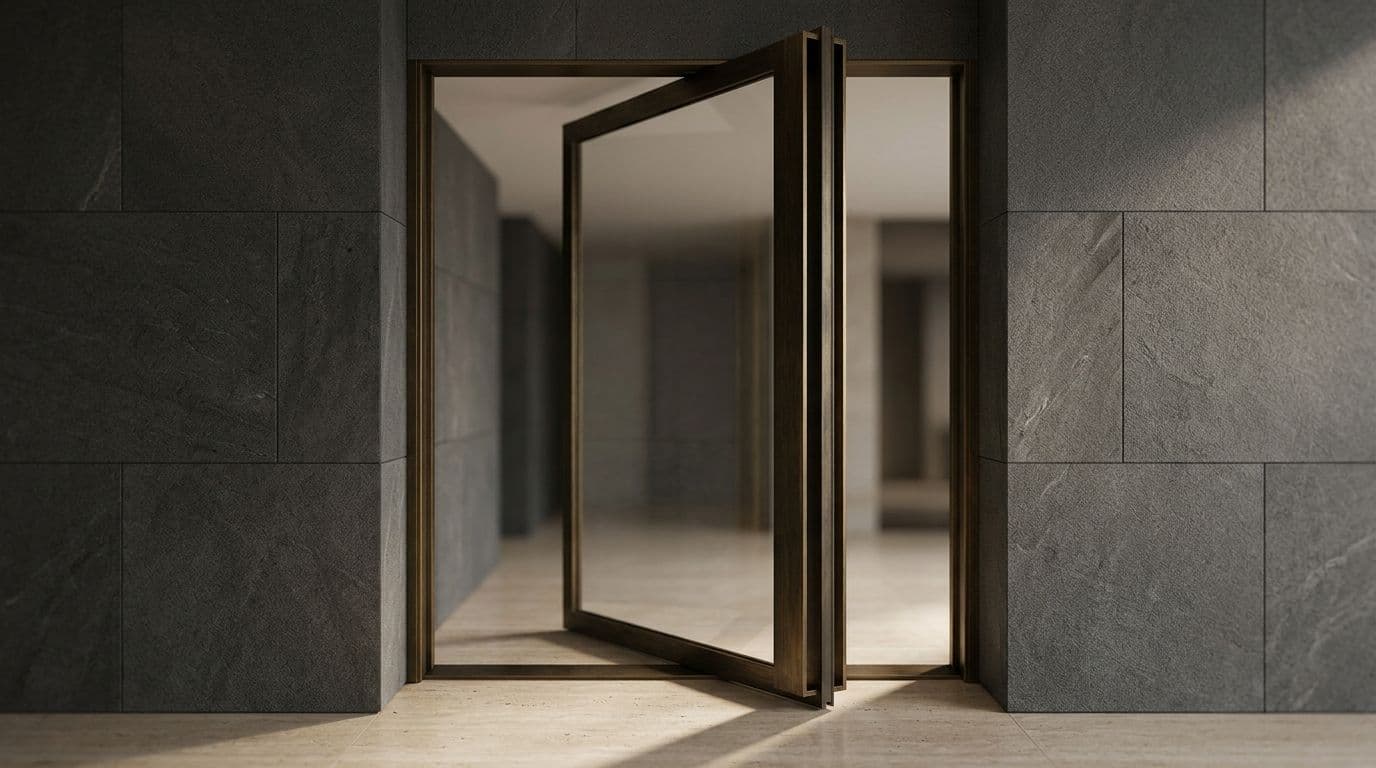
The pivot door application is the least common and the most considered. A ZEN heavy pivot door in fluted glass — up to 4,267 mm (14 feet) height, engineered pivot hardware — reads as a wall until it moves. The texture prevents it from reading as a transparent screen. It arrives as a surface, a material, a presence in the elevation.
This application suits entry thresholds, master bedroom doors, and library or study divisions where the occupant wants separation but not enclosure. The glass transmits the fact of a room behind it — a glow, an approximate shape — without delivering any of its contents. That quality is difficult to achieve with any other specification.
Finish and Thickness Options — NUMAEX
| Parameter | Options available |
|---|---|
| Glass type | Standard float · Low-iron · Back-painted (solid colour) |
| Channel depth | Shallow (≈3 mm) · Standard (≈5 mm) · Deep (≈8 mm) |
| Glass thickness | 8 mm · 10 mm · 12 mm |
| Toughening | Toughened (standard for all applications) · Laminated toughened (high-impact zones) |
| Surface | Single-sided texture · Double-sided texture (reduced privacy, increased light scatter) |
| Frame finish (SHOJI / PALOMA) | Matte black · Brushed silver · Champagne gold · Satin white · Custom RAL |
| Frame finish (ZEN) | Exposed frame · Frameless (structural silicone edge) |
Back-painted fluted glass — where the flat reverse of the sheet is painted in a solid colour prior to installation — produces a panel that reads as a coloured surface with texture. This is used in feature walls, cabinet door inserts, and retail fitouts rather than in transparent or translucent partition applications.
Specification Reference
| Application | Recommended glass | Frame system | Typical project type |
|---|---|---|---|
| Shower enclosure, standard | 10 mm toughened fluted | PALOMA aluminium, 3.5 mm wall | Residential bathroom |
| Shower enclosure, floor-to-ceiling | 12 mm toughened fluted, low-iron | PALOMA floor-to-ceiling profile | High-specification residential |
| Sliding partition, residential | 8–10 mm toughened fluted | SHOJI SUKI Minimal | Apartment, villa |
| Sliding partition, hospitality | 10–12 mm toughened fluted | SHOJI SHOGUN dual-tone | Hotel suite, restaurant private dining |
| Folding partition, large span | 10 mm toughened fluted | SHOJI multi-panel fold | Open-plan office, event space |
| Pivot door, residential | 10–12 mm toughened or laminated fluted | ZEN pivot hardware | Villa entry, master suite |
| Feature wall panel | 10 mm toughened fluted, back-painted | Fixed glazing or frameless | Retail, hospitality lobby |
All glass toughened to IS 2553 / EN 12150. Laminated options available on request. Custom dimensions confirmed at enquiry stage.
What Architects Get Wrong When Specifying Fluted Glass
Channel orientation. Vertical channels are the default — and in almost every case, the correct choice. Horizontal channels catch dust in the ridges and, in shower environments, trap water. Specify vertical. In the rare case where horizontal is required for a specific visual effect, the cleaning protocol needs to be addressed in the handover documentation.
Privacy assumptions. Fluted glass is not opaque. At distances under two metres and in strong backlight, silhouettes are clearly legible. It is a privacy treatment, not a privacy guarantee. For rooms where full opacity is required, specify back-painted glass or a layered treatment.
Edge treatment at the frame. The cut edge of fluted glass is irregular — the channels create a serrated profile at the cut face. This edge is ground flush before installation, but the connection between the glass edge and the frame rebate requires a slightly wider rebate than flat glass. Confirm with the supplier at shop drawing stage, not on site.
Thermal movement. Large fluted glass panels — anything above 1,800 mm × 1,800 mm — need the same thermal expansion clearance as flat glass of equivalent thickness. The channel pattern does not change the coefficient of expansion. The frame must accommodate it.
Frequently Asked Questions
Is fluted glass suitable for external glazing?
In most residential and hospitality applications, no — not as a single pane. The channels compromise the weathertight seal and the thermal performance of a standard insulated unit. For external applications, the fluted glass is laminated into a double-glazed unit with a flat outer pane. NUMAEX can advise on this configuration for specific projects.
Can fluted glass be cut on site?
It can be scored and broken by an experienced glazier, but the channel profile makes the cut edge unpredictable. All cutting should be done in the factory, from confirmed dimensions. Site-cut fluted glass is difficult to grind cleanly and the risk of a jagged edge at the frame is high.
How do you clean fluted glass?
Dry cloth or soft brush along the channel direction (top to bottom for vertical channels). Mild glass cleaner. No abrasive pads — the channel ridges will scratch. In shower enclosures, a daily wipe-down after use and a weekly clean with a non-acidic cleaner is sufficient to prevent soap residue in the channels.
What is the lead time for fluted glass orders?
Standard panel configurations: four to six weeks from confirmed dimensions and deposit. Custom profiles or large-format laminated units: eight to ten weeks. All lead times confirmed at order stage.
Request Fluted Glass Samples
NUMAEX holds physical samples of all current fluted glass profiles — standard float and low-iron, in shallow, standard, and deep channel depths. Samples are sent to your studio or project site. Bring them to the space. Hold them against the stone. See what the light does.
Contact the specification team at studio@numaex.com — showroom in Ahmedabad, established 1932.