The Floor You Can See Through
On glass staircases — what they demand of a building, and what they give back. A material study in structure, light, and the half-second of hesitation before you trust the tread.
There is a specific discomfort the first time you step onto a glass tread. Your foot knows the material. Your body doesn't believe it.
That hesitation — a fraction of a second, no more — is architecture doing something useful. It makes you aware of where you are. Most staircases don't bother.
What the structure is actually doing
A glass staircase is not a staircase with glass substituted in. The engineering logic is different from the start.
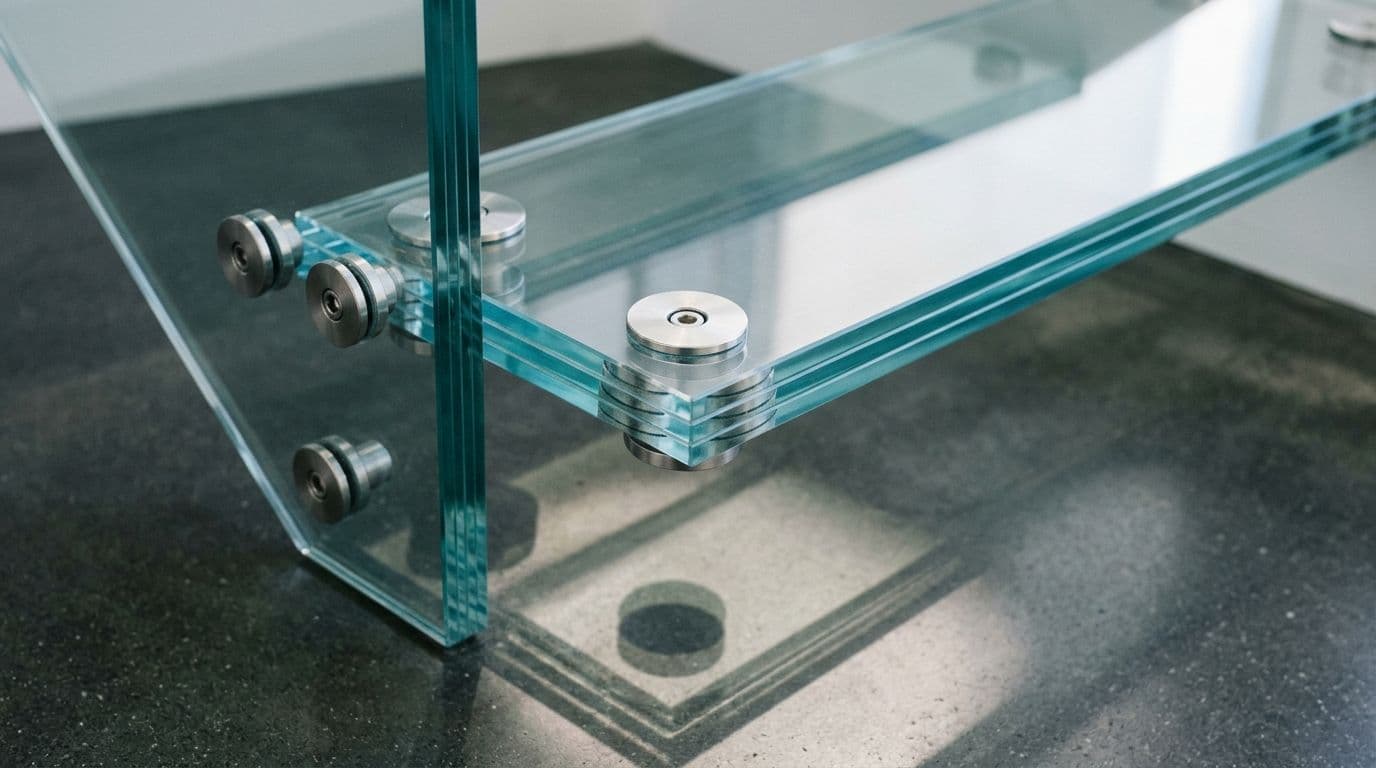
Structural glass treads are typically laminated — two or more plies of toughened glass, bonded under heat and pressure with an interlayer. The interlayer is what matters. If the outer ply fractures, the inner ply holds. The step doesn't disappear. This is called post-breakage integrity, and it is the reason the building codes in most jurisdictions permit it at all.
The treads carry load in bending, not compression. A 25mm laminated glass tread spanning 900mm will deflect under load — measurably, calculably, safely. The deflection is what the glass is designed to do. Rigidity would crack it.
Point fixings anchor the treads to a steel or glass spine. The fixings are precise things: countersunk stainless bolts, sometimes no larger than 12mm in diameter, doing the work invisibly. The whole assembly reads as floating. What it is, structurally, is cantilevered or simply supported — depending on whether there is a spine wall, a central stringer, or a frameless glass balustrade acting as the structural element itself.
The balustrade doing structural work is the part that surprises most people. A 17.5mm or 21.5mm laminated glass panel, post-fixed and properly baseplate-anchored, can resist the lateral loads a building code requires. No handrail post. No visible steel. The glass is the structure.
Five places that have understood this
The Apple Store, Fifth Avenue, New York — 2006
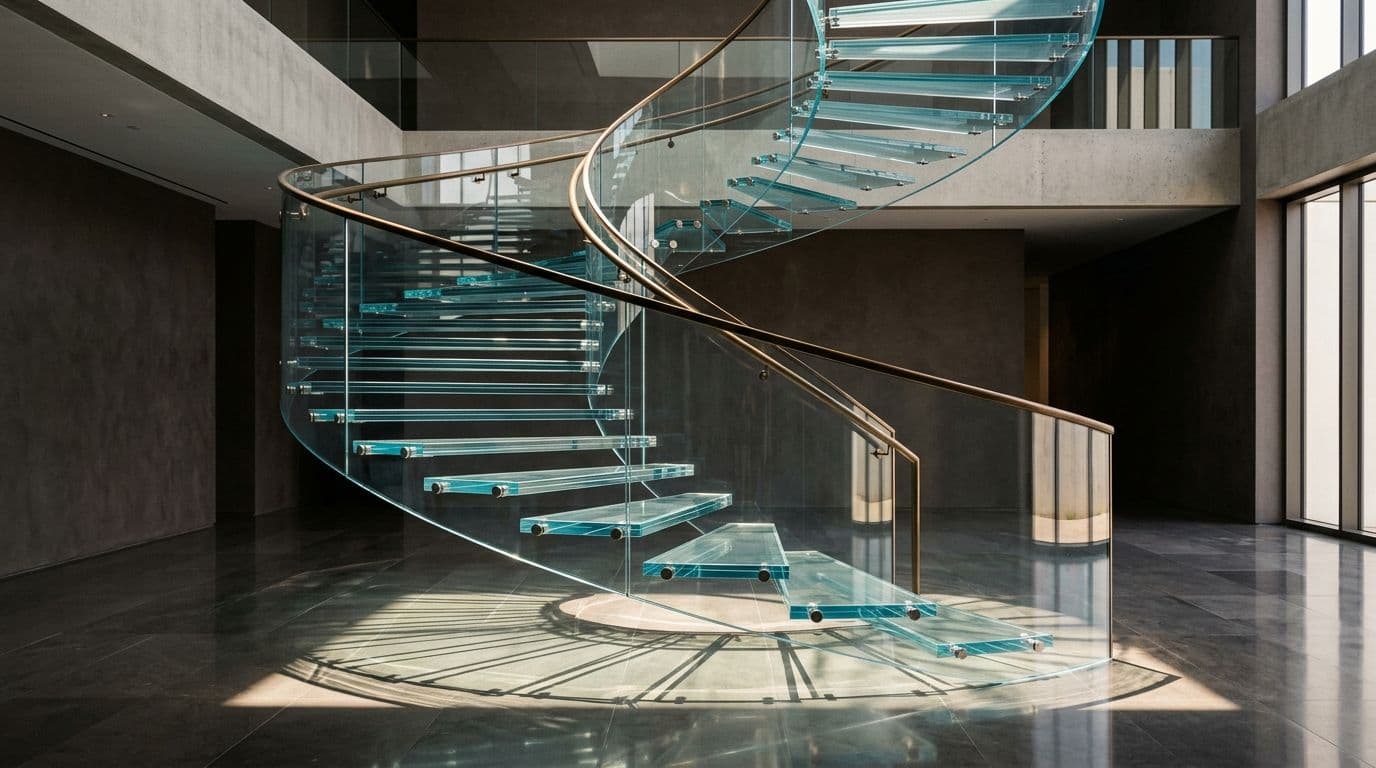
Bohlin Cywinski Jackson designed the glass cube above-ground as a landmark. Below, the helical staircase is the quieter achievement. The central spine is glass. The treads are glass. The balustrade is glass. The only non-glass structural element is the stainless steel hardware connecting them. When it opened, it was the largest all-glass staircase in the world. Apple has since rebuilt it twice — each iteration refining the glass thickness, the fixing geometry, the tread profile. The current version uses 65mm laminated treads. The effort to make something look effortless.
The Tate Modern, Blavatnik Building, London — 2016
Herzog & de Meuron's Switch House extension contains a raw concrete interior punctuated by a glass staircase that runs the full ten-storey height. The contrast is deliberate — the industrial mass of the building against the transparency of the vertical circulation. The staircase reads like a section drawing made physical. You can stand on the third floor and see the ground, and the ninth.
Louis Vuitton Maison, Champs-Élysées, Paris
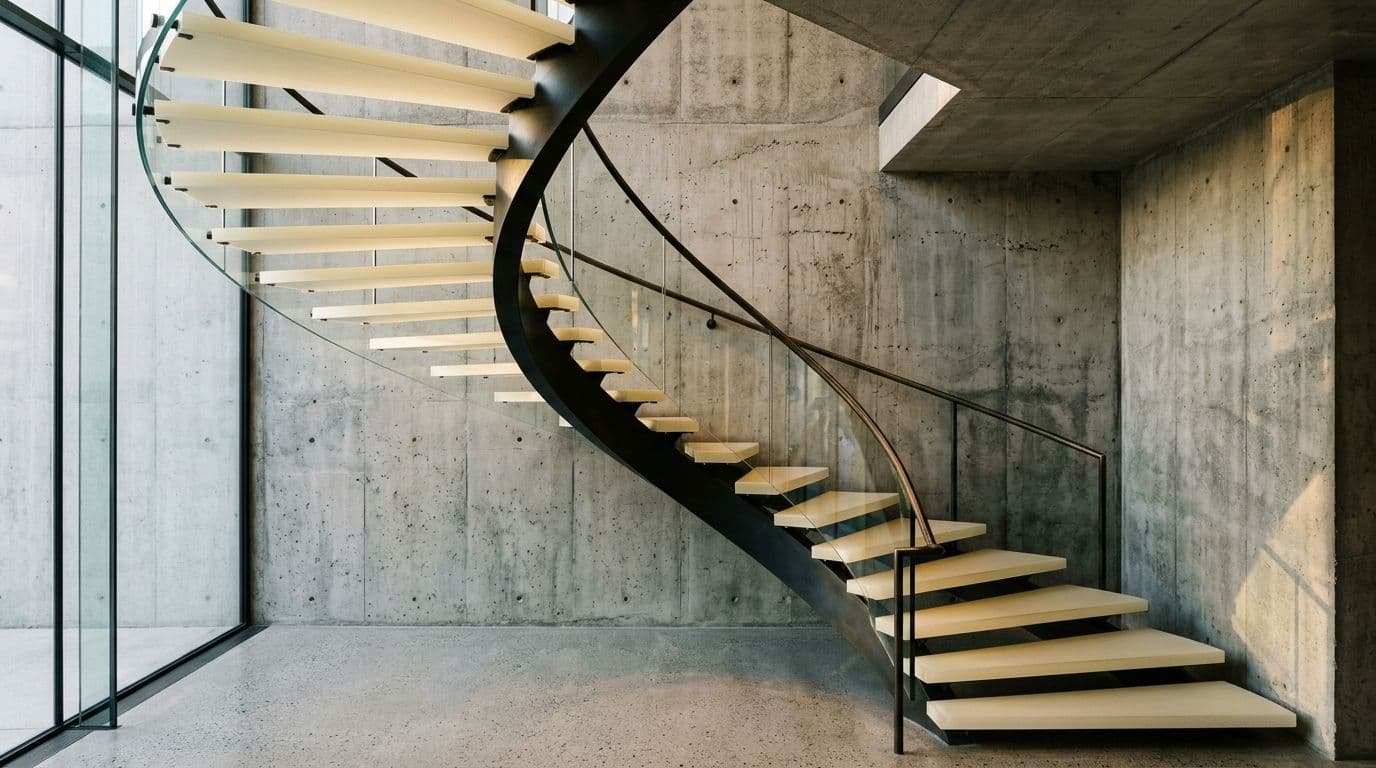
The staircase here is less about structural transparency and more about materiality. The treads are back-painted glass in a deep cream — opaque, not transparent — fixed to a curved steel spine. The effect is sculptural rather than disappearing. It demonstrates that a glass staircase is not one thing. The material can be treated, coloured, sandblasted, patterned. The tread underfoot is smooth, slightly warm from the afternoon light through the façade.
Villa Kogelhof, Zeeland, Netherlands — Paul de Ruiter Architects, 2013
A house buried almost entirely below ground, with a glass roof at grade and a staircase descending into it. The staircase is open-riser, frameless, with treads cantilevered from a single 12mm steel plate spine. The structural logic is exposed. Nothing is hidden. Standing at the bottom looking up, the sky is the ceiling and the glass treads are the foreground — a layering of transparency that the photography never quite captures.
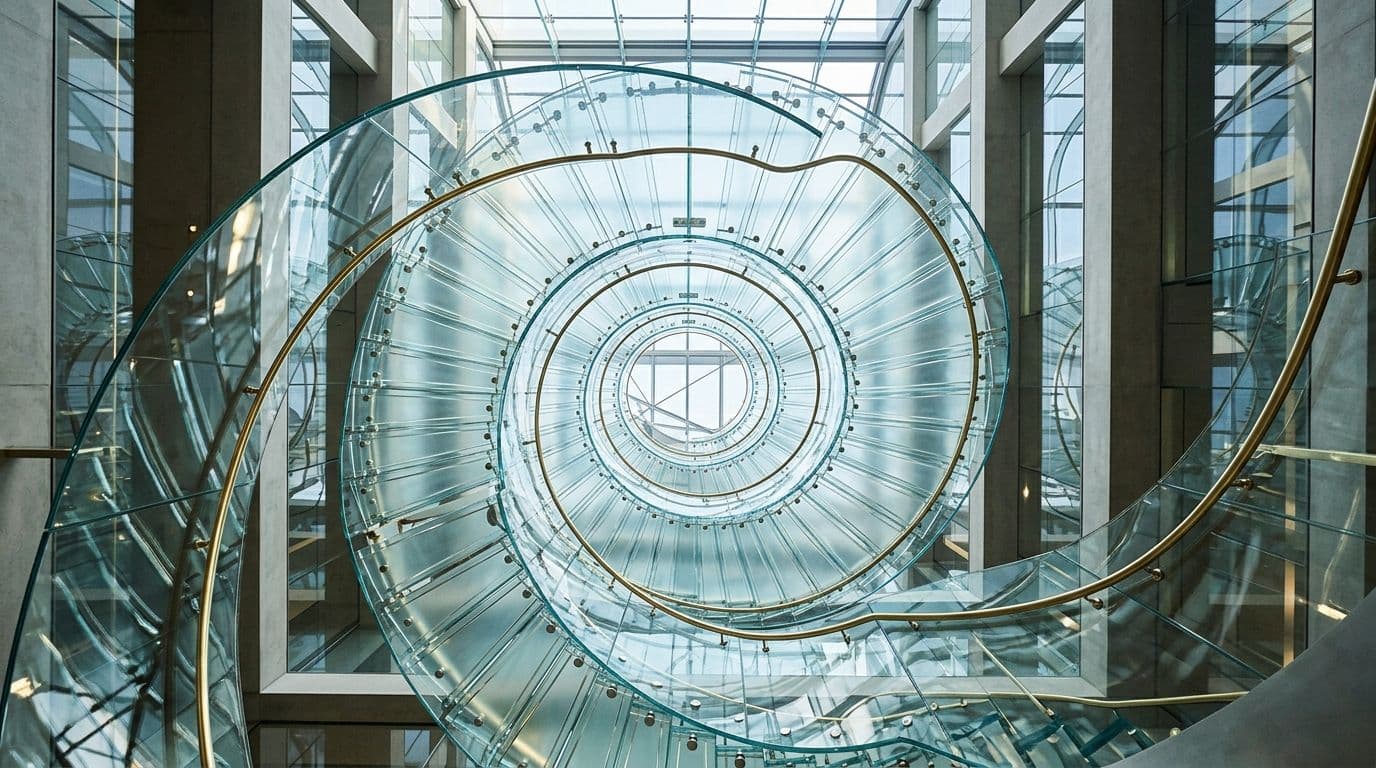
The Louvre Abu Dhabi — Jean Nouvel, 2017
The staircases here are secondary to the dome — but worth noting for the scale. Treads at 1200mm width, laminated to 28mm, connecting the exhibition galleries under Nouvel's perforated canopy. The light that falls through the dome moves across the glass treads throughout the day. The staircase becomes a sundial, incidentally.
What a glass staircase asks of a project
It asks for resolution elsewhere.
A glass staircase in a room that hasn't been thought through will expose every surrounding decision that wasn't made carefully. The ceiling above it, the floor meeting it, the wall beside it — all of it becomes visible in a way that plaster and carpet forgive. The transparency of the material is also a transparency of judgment.
It asks for maintenance the owner will actually do. Fingerprints. Footmarks. The underside of the tread, visible from below, collects dust in a way that a timber tread never makes visible. Anti-slip treatment — either acid-etched, sandblasted, or a applied non-slip interlayer — changes the surface appearance slightly. Worth knowing before specifying.
It asks for the right light. A glass staircase in a windowless internal core is a different proposition from one positioned against a façade. The former can work — backlighting, cove lighting, edge-lit treads — but it is a different project. The material rewards natural light. It does not require it.
The specification conversation
When architects specify glass treads, the variables are: laminate build-up (thickness, number of plies, interlayer type), surface treatment (clear, low-iron, back-painted, textured), anti-slip specification (sandblasted zones, applied film, or interlayer), and fixing method (point-fixed, continuous channel, structural silicone).
Low-iron glass is worth the cost. Standard float glass carries a green tint that reads through a 25mm laminate as noticeably grey-green, particularly at the edge. Low-iron glass at the same thickness reads as near-colourless — the edge is blue rather than green, and the overall reading is cleaner. On a staircase where you are looking at ten or fifteen treads simultaneously, the cumulative tint of standard glass is visible.
The interlayer choice matters for acoustics as much as safety. A standard PVB interlayer will transmit the sound of footfall fairly directly. SGP (SentryGlas) is stiffer and quieter underfoot. The tread sounds different. On a staircase in a quiet house, this is a decision worth making consciously.
What it is not
A glass staircase is not a statement of transparency as a value. It is not a metaphor for openness. It is not attempting to disappear.
It is a specific material doing specific structural work, in a position that puts it under scrutiny from every angle, for the life of the building. The ones that work — Apple, Tate, Kogelhof — work because the engineering and the geometry were resolved before the aesthetic was considered. The aesthetic followed from the resolution.
That is what good architecture is supposed to give you.